

Updated on May 07, 2025
Introduction
Ask most retailers what omnichannel retail means and they will describe selling the same products on a website, an app, a marketplace and in stores. That is a start, but it is not omnichannel. It is multichannel.
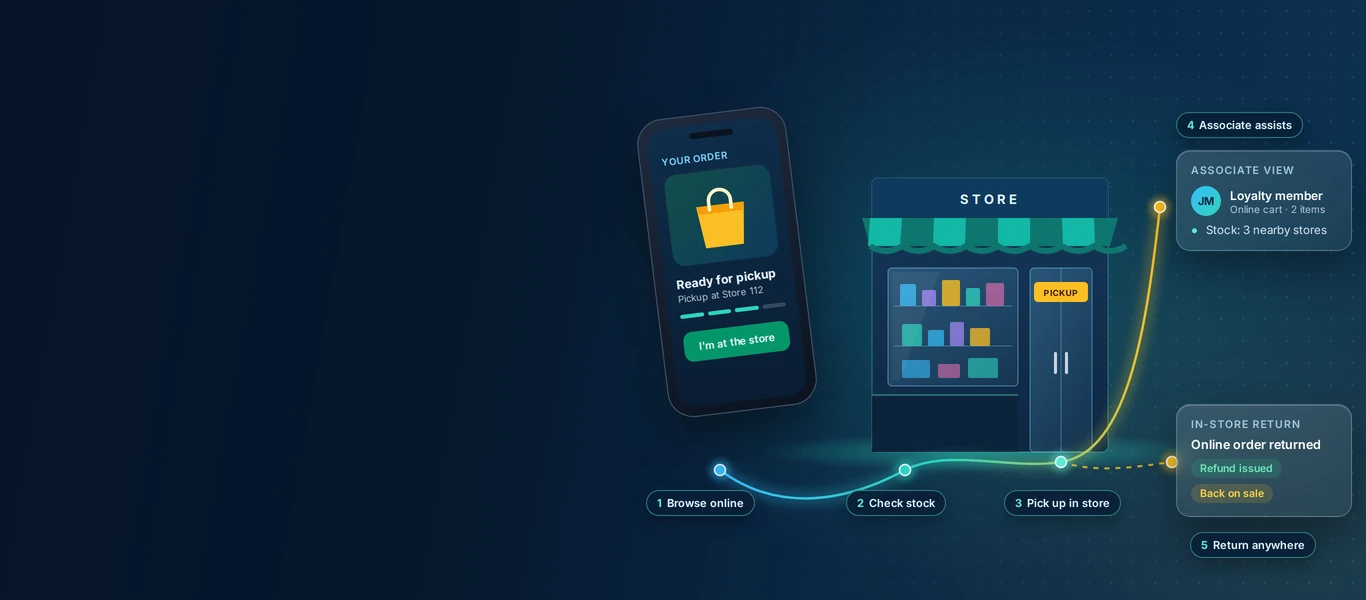
Omnichannel is a broader idea, and it starts with the customer rather than the channel. A shopper does not think in channels. She browses on her phone at lunch, checks stock at the nearest store, buys online that evening, picks up the next day and returns one item at a different store a week later. To her, that is one journey. At SkillNet we call these connected journeys, and they only hold together when the systems behind them are connected.
New microservice technologies and better use of customer data now make that possible. This guide explains what omnichannel in retail really means, how it differs from multichannel, what it looks like in practice and how to build it.
Quick Answer: What Is Omnichannel Retail?
Omnichannel retail is a retail model in which every channel a customer uses (store, website, app, marketplace and contact center) shares the same customer, inventory, order and pricing data. That lets a shopper start a journey in one channel and finish it in another without starting over.
Why Omnichannel in Retail Matters Now
Most shoppers already move between channels, whether or not the retailer’s systems keep up. In a study of more than 46,000 shoppers published in Harvard Business Review, 73% used multiple channels during their shopping journey. Those omnichannel customers spent an average of 4% more on every store visit and 10% more online than single-channel customers, and logged 23% more repeat trips to the retailer’s stores within six months.
The store is still where most of the money changes hands. According to the US Census Bureau, ecommerce accounted for 17.1% of total US retail sales in the second quarter of 2026. That means more than four in five retail dollars are still spent outside ecommerce, and many of the online orders that make up the rest are picked up, fulfilled or returned through a store.
So omnichannel in retail is not a digital project with the stores attached. It is the work of making the store, the website, the app and the contact center behave like one business. When they don’t, the customer feels the break: an item shows as available online but is not on the shelf, a loyalty discount works in the app but not at the till, or an online return is refused in store.
Multichannel vs. Omnichannel Retail: What’s the Difference?
Customers expect a consistent multichannel experience. If a coupon arrives by email, they expect it to work in store. If curbside pickup is offered, they expect it to be on time. A multichannel retailer meets these expectations by showing the same products, marketing and prices in every channel.
A familiar example: a shopper abandons a cart and, on a later visit to a marketplace such as Amazon, sees the same item at the same price. The message is consistent, but it is the same message for everyone. Pushing one product across many channels can still pay off, and it is a sensible first step. But it treats each channel as a separate shop window.
Omnichannel retail goes further. Every channel shares the same view of the customer, the inventory and the order, so the retailer can respond to what this customer is doing right now, wherever they are doing it.
| Multichannel retail | Omnichannel retail | |
| Starting point | The channel | The customer journey |
| Customer data | Held separately by each channel | One profile shared by every channel |
| Inventory | Online stock and store stock managed apart | One real-time view across distribution centers and stores |
| Orders and returns | Bought online, returned online | Buy, collect and return in any channel |
| Store associate | Sees only store transactions | Sees the customer’s online history, orders and wish lists |
| Typical result | Consistent messaging | A connected journey that adapts to each customer |

Omnichannel Retail Customer Journey Mapping
A true omnichannel retailer uses what a customer actually does to decide what happens next.
Take a shopper who keeps checking delivery options on a product page but does not buy. A multichannel retailer sends a generic 10% discount. An omnichannel retailer reads the behavior: delivery speed is the hesitation. So it offers free overnight shipping, or shows that the item is in stock for pickup today at a store two miles away. The offer costs less than a discount and answers the real question.
Or take a shopper who views the same jacket in three sizes. That is a fit question. A true omnichannel retailer would pop up an option to book a try-on appointment at the nearest store, or remind the shopper of the free in-store returns policy so the risk of ordering the wrong size disappears.
Omnichannel retailers can use this data, connected through microservices and APIs, so that the whole organization behaves like your best store associate: someone who remembers the customer, knows what is in stock and can solve the problem in front of them, in any channel.

Is your technology stack ready to act on customer behavior? Talk to our experts about an omnichannel readiness audit.
Creating a True Omnichannel Customer Experience
Building the right stack starts with reviewing the whole customer journey, not one channel at a time: inspiration, research, purchase, fulfillment, post-purchase support and the next purchase.
In a true omnichannel retailer, a successful journey creates the next one. A customer who leaves a 5-star review after collecting an order in store might receive a friends-and-family discount to share, which brings a new customer into the journey through someone they trust. That only works if the review system, the loyalty program, the order history and the promotions engine all know about each other.
The start to being a true omnichannel retailer is knowing which systems each step of the journey depends on, and where those systems do not talk to each other. Those gaps are where journeys break. The pillars below are the building blocks that close them. If you would like a second opinion on where your gaps are, talk to an expert.
Key Pillars of a Successful Omnichannel Retail Strategy
True omnichannel retail isn’t about simply being present on many channels. It is about connected, intelligent experiences that follow the customer. Omnichannel retailers need to know who the customer is, what stock is available and where every order stands, in real time. These five pillars set successful omnichannel retailers apart.
1. A Unified Commerce Platform
Pricing, promotions, product data, inventory and customer data come from one source, so the price on the shelf, the website and the app always match. In practice: a weekend promotion is set once and goes live at the same moment on the website, in the app and on every point-of-sale terminal, instead of being keyed into three systems.
2. Real-Time Inventory Visibility
Buy online, pick up in store (BOPIS), ship from store and same-day delivery all depend on knowing exactly what is on each store’s shelf. In practice: a customer orders a pair of boots online, and the system sees that the nearest store has two pairs while the distribution center is out, so the order is routed to the store instead of being canceled. See how SkillNet approaches store inventory management.
3. Centralized Customer Profiles and Loyalty Integration
One profile follows the customer across every touchpoint, so personalization and loyalty points work the same way in the app, online and at the till. In practice: a loyalty member who buys in store receives post-purchase recommendations online based on that store purchase, not on a separate online history.
4. Cross-Channel Fulfillment and Returns
Customers expect to buy, collect and return wherever is most convenient: curbside pickup, delivery from a nearby store, or an online return handled at the service desk. An order management system decides where each order is fulfilled from and keeps every channel updated. In practice: an online return accepted in store goes straight back into that store’s sellable stock instead of being shipped to a warehouse.
5. Store Associate Enablement with Mobile Tools
Store associates with mobile devices can see real-time customer, order and inventory data while standing next to the shopper. In practice: an associate looks up a size that is out of stock, finds it in another store and places the order for home delivery without the customer leaving the aisle (an “endless aisle” sale).
Examples of Omnichannel in the Retail Industry
Omnichannel in the retail industry looks different by sector, but the pattern is the same: the store and the digital channels share data so the customer never has to start again. Some common types of omnichannel retail:
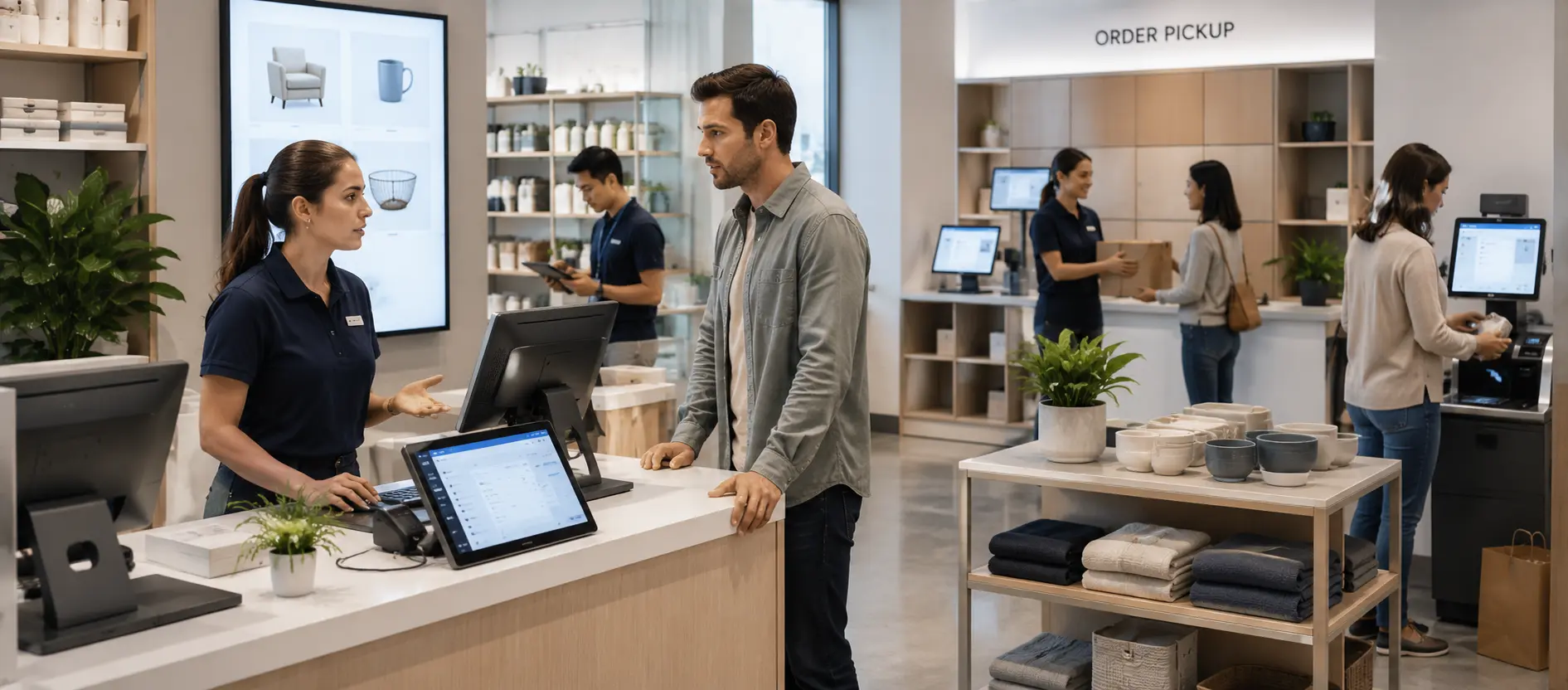
- Buy online, pick up in store (BOPIS) and curbside pickup: The customer orders online and collects in store, often the same day. Pickup also brings people through the door: in a Doddle survey of more than 2,000 US shoppers reported by Retail Dive, 85% said they had made additional purchases in store while collecting an online order.
- Ship from store: Stores act as small fulfillment centers, so online orders ship from the location closest to the customer.
- Buy online, return in store (BORIS): Online orders can be returned at any store, and the item goes back into local stock.
- Endless aisle: Associates sell items that are not on the shelf by ordering them from another store or the distribution center.
- Clienteling and appointments: Associates use the customer’s online history and wish lists to prepare personal styling or try-on appointments.
How this plays out in different parts of the retail industry:
- Apparel and footwear: Size and fit drive returns, so try-on appointments, BORIS and store-to-store transfers matter most.
- Grocery: Online orders are picked in store for curbside pickup or delivery, so shelf-level inventory accuracy decides whether substitutions are needed.
- Health and beauty and pharmacy: Customers expect loyalty points, prescriptions and offers to follow them between the app and the counter.
- Specialty retail: Endless aisle extends a small store’s range without adding floor space.
Large retailers show what this looks like at scale. Walmart, for example, uses its stores as fulfillment points for online pickup and delivery orders, making it one of the most cited examples of omni-channel in the retail industry. For a deeper look at fulfillment models, read BOPIS, ROPIS, BORIS, BOSS: Are You Ready for Omnichannel Fulfillment?
Omnichannel in Retail: How to Build Your Strategy in 5 Steps
The pillars describe what an omnichannel retailer needs. These steps describe where to start.
1. Map the journey and find where it breaks
Walk through your most common cross-channel journeys as a customer would. Where do they have to repeat information, wait, or get a different answer? Those points are your priorities. A typical finding: an online order cannot be returned at the till because the POS cannot see it.
2. Audit how your core systems connect
List the systems each journey touches (POS, order management, ecommerce platform, CRM and loyalty, merchandising, warehouse) and how data moves between them: real time, nightly batch or not at all. Nightly batches are usually where inventory and pricing drift apart.
3. Fix inventory accuracy before you promise anything
BOPIS and ship from store fail if store stock is wrong. Get shelf-level accuracy and real-time updates in place before advertising same-day pickup.
4. Pilot one connected journey
Choose a single journey, such as BOPIS in a group of stores, and run it end to end: order online, inventory check across distribution centers and stores, routing to the nearest store, associate pick, customer collection and an in-store return. A pilot exposes integration gaps faster than any design document.
5. Measure, then scale
Track pickup time, order cancellations, inventory accuracy, cross-channel customer value and associate adoption. Scale to more stores and more journeys once the numbers hold.
Common Challenges Retailers Face
- Legacy POS and store systems that were never designed to see online orders or share inventory in real time. See SkillNet’s POS modernization services.
- Inventory accuracy at shelf level, especially in stores that also fulfill online orders.
- Customer data in silos across ecommerce, loyalty, CRM and the store, so no channel sees the whole customer.
- Store adoption: new pickup, ship-from-store and returns processes add work to associates who are already busy, so training and simple tools matter.
- Returns across channels, where the refund, the stock and the customer record have to update together.
SkillNet’s Approach to Omnichannel Transformation
SkillNet Solutions, Makers of Modern Commerce, has spent 25+ years in retail technology and delivered projects across 63+ countries for B2B, B2C and B2B2C retailers. We align customer experience strategy with technology modernization, with deep store systems expertise across POS, order management and merchandising. We work across the major commerce and retail ecosystems, including Oracle Retail, SAP Commerce Cloud, Salesforce, Adobe Commerce, Spryker, VTEX, Mirakl and AWS. Our omnichannel retail solutions include:
- POS modernization and integration: Modern store platforms, including Oracle Xstore, that support endless aisle, BOPIS and clienteling.
- Cloud-based architecture: Microservices and real-time APIs that let channels share data instead of copying it overnight.
- Real-time data syncing: Customer profiles, inventory and orders kept current across every channel, supported by integration accelerators such as StoreHub.
- CX-led journey mapping and testing: Finding where journeys break and testing the fix before it reaches customers.
Frequently Asked Questions
1. What is omnichannel retail?
Omnichannel retail is a retail model in which the store, website, app, marketplace and contact center share the same customer, inventory, order and pricing data. Customers can start a purchase in one channel and finish, collect or return it in another without starting over.
2. What is the difference between omnichannel and multichannel retail?
Multichannel retail sells through several channels that run separately, each with its own data. Omnichannel retail connects those channels so they share one view of the customer, inventory and orders. Multichannel delivers consistent messaging; omnichannel delivers one connected journey.
3. What are some examples of omnichannel retail?
Common examples include buy online, pick up in store (BOPIS), curbside pickup, ship from store, returning online orders in store (BORIS), endless aisle ordering by store associates, and try-on or styling appointments booked online and fulfilled in store.
4. What are the four C’s of omnichannel?
There is no single official list, but the four C’s are usually given as consistency, convenience, context and connection: the same prices and information everywhere, easy ways to buy and collect, experiences that reflect what the customer has already done, and channels that share data. In practice, all four depend on connected systems behind the scenes.
5. Is Walmart an omnichannel retailer?
Yes. Walmart is widely cited as an omnichannel retailer because it uses its stores to fulfill online pickup and delivery orders, connecting its website, app and physical stores into one shopping journey.
6. Why is omnichannel important in retail?
Most shoppers already use more than one channel. A Harvard Business Review study of more than 46,000 shoppers found that 73% used multiple channels, and those omnichannel customers spent more both in store and online. Retailers that connect their channels keep those customers; retailers that don’t lose them at the points where the journey breaks.
7. What technology does a retailer need for omnichannel?
The core systems are a modern POS, an order management system (OMS), real-time inventory visibility across stores and distribution centers, a commerce platform, and a shared customer profile linked to loyalty. Just as important is the integration layer that keeps those systems in sync in real time.
8. Is omnichannel retail the same as unified commerce?
They are closely related. Omnichannel describes the connected customer experience across channels. Unified commerce describes the technology approach behind it, where channels run on one shared platform and data model rather than separate systems linked together. Many retailers use unified commerce to deliver omnichannel retail.
Ready to Connect Every Customer Journey?
Omnichannel retail is not about adding another channel. It is about making sure every channel you already have tells the same story about the same customer, the same stock and the same order. Retailers that get this right build connected journeys that bring customers back, and the store sits at the center of them.
Whether you are starting with BOPIS, replacing a legacy POS or connecting inventory across stores and distribution centers, SkillNet can help you find where your customer journeys break and fix them. Book a free consultation with our retail experts.
Related reading: BOPIS, ROPIS, BORIS, BOSS: Are You Ready for Omnichannel Fulfillment?


 omnicanal e lojas
 Engenharia
 Technology Consulting