

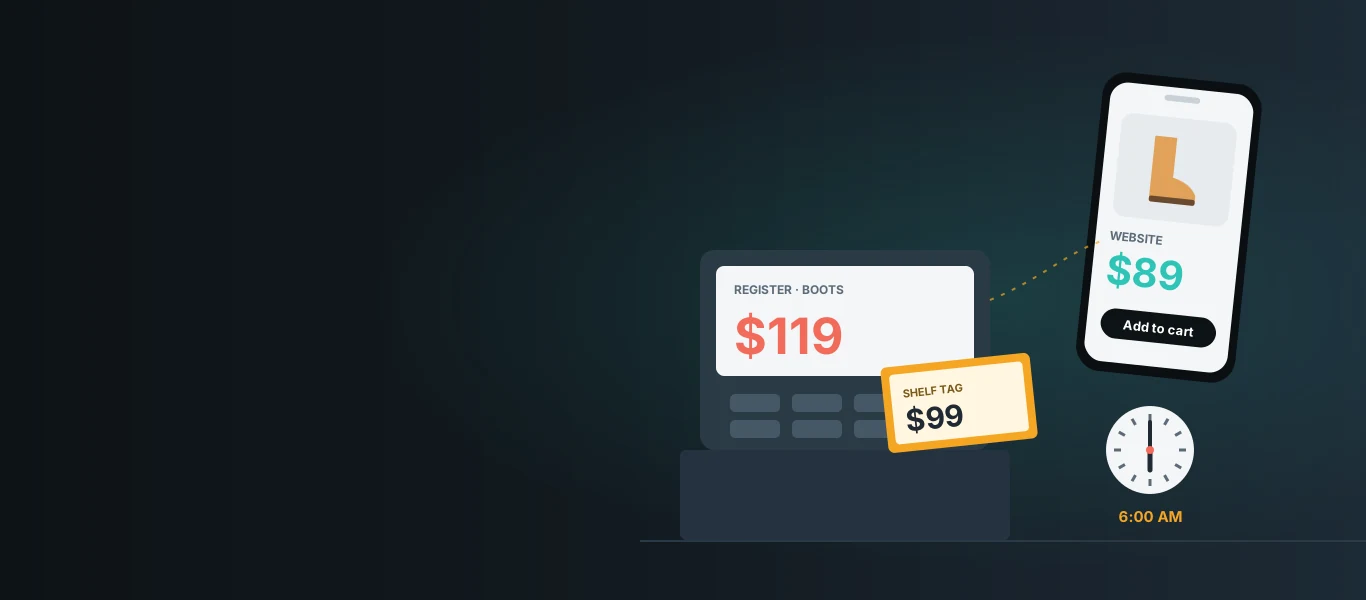

At 6 AM on Black Friday a shopper walks up to the register with her phone in her hand. The website shows the boots at $89. The register rings them at $119. The shelf tag, printed on Tuesday, says $99. The prices are an example. Anyone who has worked a holiday morning has seen some version of it.
Every promotion starts as one decision. Before the doors open, that decision has to reach the ecommerce platform, the point of sale in every store, the shelf labels, the mobile app, and the marketplace listings. Each of those systems usually gets its prices on its own schedule.
NRF expects 182.7 million people to shop over Thanksgiving weekend, and 126 million of them plan to shop on Black Friday itself. Of those Black Friday shoppers, 67% say they are likely to shop in stores and 89% online.
Find out where each price comes from
Pick five items in this weekend’s promotion. For each one, write down where the website, the point of sale, the shelf label, and the app get their price, and when each last received an update. If the answer for any channel is the overnight batch, you know the earliest moment a mid-day change can show up there.
Check the till, not the plan
The promotion calendar says what should happen. The register says what did. Before opening, have one person in two or three stores scan the five items and compare the till price with the website. Do it again after any change during the day. Ten minutes of scanning finds the gap before a customer does.
Decide the rule before the line forms
Some mismatches will get through. Write down what the associate does when the website and the till disagree: honor the lower price, up to what amount, and who approves above it. Put the rule where the associate can see it. A clear rule keeps the line moving and gives the same answer in every store.
Treat the mid-weekend change as a release
Many retailers adjust offers between Friday and Cyber Monday. That change travels the same path as the first one, under more pressure. Name an owner, set a cutoff time, and run the five-item check again after it lands.
A test to run this week
Choose one promoted item. On the next planned price change, time how long the new price takes to appear on the website, at the register in two stores, and on the shelf label. The slowest channel sets the real start time of your promotion.
When a price change has to be keyed or sent again for each channel, the gaps are built in. SkillNet works on the systems that carry a price from merchandising to the store, so a change made once can reach every channel on time.
Heading to NRF 2027? Meet SkillNet at booth 1427.
Source
National Retail Federation and Prosper Insights & Analytics, Thanksgiving weekend shopping survey of 7,956 adults, conducted October 30 to November 9, 2026, released November 19, 2026. https://nrf.com/media-center/press-releases/183-million-consumers-expected-to-shop-during-thanksgiving-weekend
FAQs
1. Why do prices differ between the shelf, the website and the register on Black Friday?
Every promotion starts as one decision, but the website, the point of sale, the shelf labels, the app and the marketplace listings usually each get their prices on their own schedule. If any channel only updates in the overnight batch, a mid-day change cannot reach it until the next run.
2. How can a retailer check prices across channels before the doors open?
Pick five promoted items. Note where each channel gets its price and when it last updated. Before opening, have one person in two or three stores scan the five items and compare the till price with the website, then repeat after any change during the day.
3. What should an associate do when the website and the till show different prices?
Follow a written rule: for example, honor the lower price up to a set amount, with a named approver above it. Put the rule where associates can see it, so the line keeps moving and every store gives the same answer.
4. How should retailers handle price changes between Black Friday and Cyber Monday?
Treat the mid-weekend change as a release. Name an owner, set a cutoff time, and run the five-item check again after the change lands. Time how long the new price takes to reach each channel: the slowest one sets the real start of the promotion.


 omnicanal y tiendas
 Ingeniería
 Technology Consulting