


Omnichannel Retail
The Complete Guide to Unified Commerce, Fulfillment, and Retail Technology
Hable con un Experto / Recursos / Omnichannel Retail: The Complete Guide to Unified Commerce, Fulfillment, and Retail Technology
The Complete Guide to Omnichannel Retail Commerce
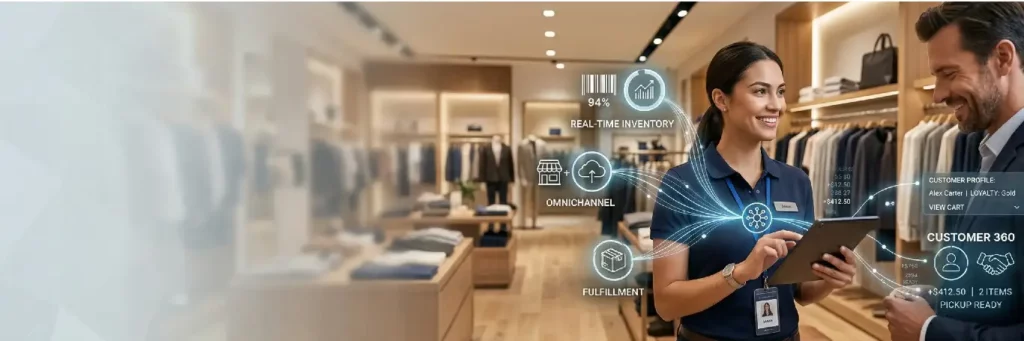
The modern retail system has shifted from a linear journey to a complex web of touchpoints where consumers expect total fluidity. Survival no longer depends on simply having an online store and a physical location. It requires a unified ecosystem where inventory, data, and customer experience are synchronized in real time.
This guide provides a strategic roadmap for retail leaders to navigate this transformation. We break down the technical architecture and operational shifts required to move from fragmented systems to a truly unified commerce model.
What Is Omnichannel Retail — Really?
True omnichannel retail is not just “selling everywhere.” While multichannel retail involves having multiple independent silos (a website, an app, and a store), omnichannel is the integration of those silos. It ensures that a customer’s basket on their mobile app is identical to their basket when they log in via a desktop or speak to a store associate.
Omnichannel vs. Multichannel vs. Unified Commerce
Multichannel retail often leads to “broken” experiences where a customer sees an item online but finds it unavailable in the store. Unified commerce solves this by placing a single platform at the center of the business. This platform acts as the “golden record” for all inventory, customer, and pricing data.
Why the Traditional Model Is Broken
Legacy retail models were built for a world where stores were the end of the supply chain. Today, stores are fulfillment centers, showrooms, and return hubs.
Systems that cannot communicate in real time create friction, leading to lost sales and diminished brand loyalty.
The Five Pillars of True Omnichannel Retail
- Centralized Inventory: A real-time view of stock across all nodes.
- Unified Customer Profiles: Knowing the customer’s history regardless of where they shop.
- Cross-Channel Fulfillment: Allowing customers to buy, pick up, and return anywhere.
- Consistent Pricing: Synchronized promotions and prices across digital and physical touchpoints.
- Mobile Empowerment: Giving store associates the tools to “save the sale” via endless aisle capabilities.
Read More: What Is Omnichannel Retail, It May Not Be What You Think →
The Omnichannel Fulfillment Playbook
Fulfillment has become the primary differentiator in the retail experience. If a customer cannot get a product when and where they want it, they will find a competitor who can.
BOPIS (Buy Online, Pick Up In Store) — How It Works
BOPIS has moved from a convenience to a requirement. The process relies on a tight integration between your e-commerce engine and your retail inventory management systems. When an order is placed, the system must instantly “ring fence” that inventory at the local store, alert a store associate to pick and pack the order, and notify the customer when it is ready.
ROPIS, BORIS, and BOSS Explained
- ROPIS (Reserve Online, Pick Up In Store): This model allows customers to reserve items without immediate payment, bringing them into the store to try the product, which significantly reduces return rates.
- BORIS (Buy Online, Return In Store): This is a major traffic driver. It gives customers a reason to visit a physical location, where associates can use “save the sale” tactics to offer exchanges or additional items.
- BOSS (Buy Online, Ship to Store): If a local store is out of stock, the order is shipped from a DC to that store for pickup. This saves the customer shipping costs and increases the likelihood of an impulse buy during pickup.
Choosing the Right Fulfillment Model for Your Store Network
Not every store is suited for every model. High-volume flagship stores may act as mini distribution centers, while smaller boutique locations might only support ROPIS. Your network strategy should be dictated by your local density and the speed of your replenishment cycles.
Common Implementation Pitfalls to Avoid
The most common failure is “phantom inventory.” If your systems are not updating in real time, a customer might buy an item online that was just sold to a walk-in customer minutes prior. Other pitfalls include poor in-store signage for pickups and failing to incentivize store staff for digital fulfillment.
POS as the Omnichannel Nerve Center
The Evolved Role of Modern Omnichannel POS Systems
The Point of Sale has transformed from a simple “cash wrap” to the primary interaction point for all unified commerce services. Modern omnichannel POS systems act as the strategic hub where digital orders are processed, loyalty is built, and the “endless aisle” is accessed.
Must-Have Omnichannel POS Capabilities
A modern retail POS solution must be mobile, cloud native, and deeply integrated. Key capabilities include:
- Global Inventory Lookup: Allowing an associate to find an item in another store or the warehouse instantly.
- Mixed Carts: Processing a transaction where one item is taken from the shelf, and another is shipped to the customer’s home.
- Unified Loyalty: Applying digital coupons and points to an in-person transaction regardless of where the customer earned them.
Oracle Retail Xstore POS: Case Study Insights
Retailers across diverse verticals use Oracle Retail Xstore POS to anchor their omnichannel efforts. This includes home improvement leaders like SINSA in Central America, who modernized their store systems to enhance customer experience, as well as premier fashion and specialty retailers globally.
By utilizing Xstore, these brands have unified their physical stores with backend merchandising. This allows for a 360-degree view of the business and ensures that high-volume transactions are handled with sophisticated data precision.
Signs Your Current POS Is Holding Back Growth
If your POS requires manual data batches to sync with your website, your technology is a liability. Legacy systems often lack the API connectivity required to plug into modern omnichannel retail technology. When associates have to leave a customer to check stock in the back room, it indicates that your current system cannot support the fluidity of modern commerce.
How to Evaluate and Select a Modern POS Platform
Look for a platform that prioritizes mobile-first architecture and API first connectivity. It is vital to evaluate a partner’s track record. For instance, SkillNet has been an Oracle Retail implementation partner since 2005 and has completed over 200 successful POS engagements. Ensure the platform you choose can scale as your business expands into new markets or complex fulfillment models.
Read More: Omnichannel Capabilities of Oracle Retail Xstore POS →
Order Management Systems — The Backbone
Scaling with Retail Order Management Systems
If the POS is the nerve center, the Order Management System (OMS) is the brain that orchestrates the entire order lifecycle. Retailers cannot scale unified commerce without an OMS to automate the complex logic of routing orders across a global network. It transforms “buy” clicks into physical deliveries by determining the most efficient fulfillment path in real time.
OMS vs. ERP vs. WMS: Key Distinctions
Confusing retail order management systems with ERPs or WMS architectures leads to significant bottlenecks
- ERP: Handles high-level financial and administrative “business” data but lacks the agility for real-time, high-velocity order routing.
- WMS: Manages granular “inside the four walls” warehouse movements like picking and packing, but has no visibility into store-level stock.
- OMS: Acts as the connective tissue that sits above both. It coordinates orders across all channels and locations, providing the “golden record” for the entire order journey.
Key OMS Capabilities
- Distributed Order Management (DOM): Intelligent routing based on proximity, shipping costs, or the need to clear aged inventory at specific stores.
- Enterprise Inventory Visibility: An aggregated, real-time view of all stock across stores, warehouses, and partners.
- Fulfillment Flexibility: The ability to handle complex scenarios like split shipments or partial returns seamlessly.
Implementation: Phased vs. Big Bang
The “Big Bang” approach carries extreme risk for established retailers. We recommend a phased rollout:
- Visibility: Establish a single view of inventory across the enterprise.
- Execution: Launch basic omnichannel services like BOPIS.
- Optimization: Implement complex logic like Ship-from-Store to maximize efficiency. This approach reduces operational friction and allows your team to adapt to new workflows incrementally.
Choosing the Right OMS
The ideal OMS must be API first and technology-agnostic to integrate with both legacy and modern stacks. Prioritize a system that allows you to change fulfillment rules in hours rather than weeks. This ensures your organization remains agile enough to respond to sudden market shifts or peak season demands.
Read More: Omnichannel Enablement with Order Management Systems →
POS Data, Analytics, and Predictive Intelligence
In a unified commerce environment, your POS system is the primary sensory organ of your business. It captures the “what,” “where,” and “when” of every transaction. However, the true value lies in the “why” and the “what next.”
Why POS Data Is Your Most Valuable Omnichannel Asset
POS data serves as the bridge between digital intent and physical action. When integrated correctly, it allows retailers to track a customer who researched a product on a mobile app and completed the purchase in a physical store. This attribution is the only way to accurately measure the ROI of your omnichannel retail strategy. Without this data link, you are essentially flying blind regarding your customers’ true path to purchase.
Real-Time Analytics Use Cases in Retail
Modern omnichannel retail technology allows for immediate action based on incoming data streams.
- Dynamic Labor Allocation: If POS data shows a sudden spike in foot traffic or BOPIS pickups at a specific location, managers can reallocate staff in real time to prevent service bottlenecks.
- Instant Fraud Detection: Real time auditing of transactions across all channels helps identify suspicious patterns, such as multiple high value returns across different stores, before they impact the bottom line.
- Personalized In-Store Offers: By recognizing a loyalty member at the point of sale, the system can trigger a personalized discount based on their online browsing history, effectively “saving the sale” or increasing the basket size.
Predictive Insights: From Reactive to Proactive Retail
The industry is moving away from reactive reporting, looking at what happened yesterday, toward proactive intelligence. Predictive models use historical POS data combined with external factors like weather, local events, and social trends to forecast demand with high precision. This ensures that your retail inventory management systems are stocked appropriately before the demand arrives, reducing both stockouts and forced markdowns.
Building a POS Data Architecture That Scales
To turn data into a competitive advantage, the underlying architecture must be robust. A scalable data architecture involves:
- Cloud Native Integration: Moving data to platforms like OCI or AWS to ensure high availability and processing power.
- Data Harmonization: Ensuring that data formats from legacy POS systems and modern e-commerce platforms are standardized into a single “golden record.”
- API First Connectivity: Allowing third-party AI and BI tools to plug into your data stream without disrupting core operations.
From Data to Decisions: A Retail Analytics Maturity Model
Retailers typically move through four stages of data maturity:
- Descriptive Analytics: Utilizing basic reports to understand past sales performance.
- Diagnostic Analytics: Mining data to understand why certain stores or products underperformed.
- Predictive Analytics: Forecasting future trends and customer behaviors using machine learning.
- Prescriptive Analytics: Utilizing AI to suggest specific actions, such as “Move 200 units of this SKU from Store A to Store B to meet projected weekend demand.”
Read More: How POS Data Powers Real-Time Analytics & Omnichannel Retail →
Building Your Omnichannel Retail Roadmap
Successfully transitioning to unified commerce is not an overnight event. It requires a structured approach that prioritizes high-impact wins while building a foundation for long term scalability.
Assessing Your Omnichannel Maturity Level
Before investing in new omnichannel retail technology, you must understand where you stand. Are your inventory systems updated in real time? Can your store associates access a customer’s online wish list? Identifying these gaps is the first step in the transformation process.
The 5-Phase Omnichannel Transformation Framework
- Phase 1: Foundation: Modernizing core systems like the POS and OMS to ensure data can flow freely.
- Phase 2: Visibility: Implementing retail inventory management systems that provide a single view of stock across the enterprise.
- Phase 3: Enablement: Launching basic omnichannel services like BOPIS and BORIS.
- Phase 4: Optimization: Using AI and retail accelerators to refine fulfillment logic and reduce operational costs.
- Phase 5: Innovation: Exploring next-gen capabilities like AR showrooms, cashierless checkout, and hyper-personalized loyalty journeys.
Change Management: People, Process, and Technology
The biggest hurdle to omnichannel success is often not the technology, but the culture. Store associates must be incentivized to help with online fulfillment, and corporate silos between “e-commerce” and “retail” teams must be dissolved. Alignment across these three pillars is mandatory for a successful rollout.
Working with an Omnichannel Implementation Partner
Many retailers struggle with the complexity of integrating legacy systems with modern cloud solutions. SkillNet solutions provide the bridge, offering specialized Servicios de Comercialización Minorista y POS implementation expertise. By working with a partner who understands the nuances of global retail, you can avoid common pitfalls and accelerate your time to value.
Conclusion and Next Steps
The distinction between “online” and “offline” retail has vanished. In its place is a single, unified reality where the customer is the center of the universe. By mastering fulfillment, modernizing your POS, and leveraging predictive intelligence, you position your brand to thrive in this new era.
Key Takeaways Summary
- Omnichannel is a strategy of total integration, not just multiple sales channels.
- Fulfillment models like BOPIS and BORIS are the primary drivers of modern store traffic.
- A modern POS acts as the nerve center for both transactions and customer data.
- Scaling without a robust Order Management System (OMS) is virtually impossible.
- Predictive analytics allows retailers to move from reactive fixes to proactive growth.
- A phased roadmap ensures that technology investments deliver measurable ROI.


Póngase En Contacto Con Nosotros
SkillNet Solutions, Makers of Modern Commerce, brinda servicios de consultoría y tecnología a empresas que se están transformando digitalmente en empresas comerciales modernas.