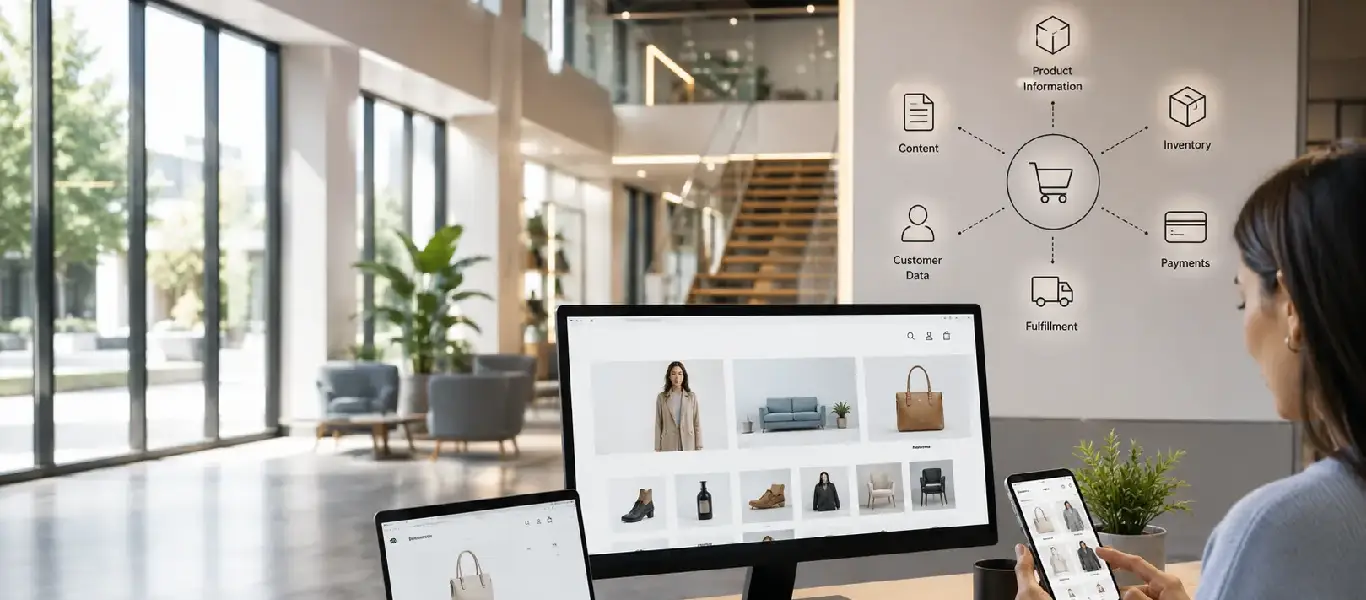



Every system promises insight. The point of sale is where that promise gets tested.
If POS data is the truth about what actually happened in your stores, then POS architecture is how quickly and reliably you can act on that truth. The shift from standalone registers to connected platforms is what turns checkout from a necessary step into a strategic advantage.
This article looks at how POS has moved from register to platform, why that matters now, and what retail IT leaders and enterprise architects should keep in mind when they design for the next decade of unified commerce.
From Standalone Registers to Connected Platforms
For years, “POS” in retail meant the register at the counter. It rang up items, opened the drawer, printed a receipt, and that was it.
That definition no longer fits.
Traditional POS was simple and siloed. Stores relied on hardware-heavy, on-premise registers that could:
- Ring up sales
- Open the cash drawer
- Print a receipt
They did those core tasks, but not much else. Each store often had its own system, with data moving in overnight or weekly batches. That created familiar problems:
- Fragmented data: Each location kept its own view of sales and stock until batch updates.
- Slow change cycles: Price changes, promotions, and new features rolled out store by store.
- Limited visibility: Central teams lacked a real-time view of performance or inventory across the network.
At the same time, shopper expectations kept rising. Customers now expect speed, flexibility, and consistency across channels.
They want:
- Contactless and mobile payments
- The ability to buy online and pick up in store
- The option to order out-of-stock items from another store or warehouse
- Consistent prices and promotions across web, app, and stores
Industry data reflects the pressure. Nearly 90% of shoppers say the checkout experience influences their opinion of a brand, and 66% expect checkout to take under four minutes. Legacy registers were never designed for that reality.
Over the last decade, those pain points have pushed retailers toward platform-based POS:
- As of 2024, more than 52% of businesses are all-in on cloud-based POS, with another 40% planning to shift.
- By 2025, roughly 72% of retailers use cloud POS systems, helped by an average 22% better total cost of ownership (TCO) compared to traditional setups.
- In one industry analysis, 85% of operators named integration capabilities as their top priority when they choose POS software.
Taken together, these numbers show a clear mindset shift. POS is no longer a standalone transaction tool. It is a central hub of real-time retail data and services.
Cloud POS and Headless Commerce as Key Enablers
Two technology trends sit underneath this shift: cloud-based POS and headless commerce.
Cloud POS
With cloud-based POS, core logic and data move from each store’s register into a central cloud environment. This brings several concrete advantages:
- One live view of the business. Sales and inventory from all locations are consolidated in real time, instead of waiting for end-of-day files.
- Faster change cycles. New features, bug fixes, and security updates are pushed centrally, without onsite installs.
- Elastic scale. If traffic spikes or new stores open, capacity can scale with demand instead of hitting hardware limits.
Cloud POS adoption is growing at nearly 19% CAGR through 2030, as retailers look for agility and lower operational overhead. Platforms that handle scaling and updates centrally free IT teams to focus on higher-value work.
Headless commerce
Headless commerce separates the front end from the back end.
- The front end is everything the cashier or customer sees and touches: POS screens, mobile apps, self-checkouts, kiosks, and ecommerce sites.
- The back end is the shared set of services for pricing, catalog, promotions, inventory, and payments.
These layers talk to each other in real time through APIs.
This architecture gives retailers the flexibility to:
- Deploy multiple touchpoints, such as registers, tablets, kiosks, clienteling apps, and web and mobile checkout, all on top of the same core services.
- Customize the user experience by device or context without rewriting the underlying business logic.
- Keep pricing, promotions, and stock consistent across channels in real time, because every channel is reading from the same source of truth.
Headless, API-first platforms also make it easier to add specific services. For example, teams can introduce curbside pickup, AI-driven recommendations, or a new payment provider as separate services connected to the POS platform through APIs, without disrupting front-end experiences.
Many modern POS solutions now follow MACH principles: microservices, API-first, cloud-native, and headless. This composable design is the essence of POS as a platform. You can mix and match capabilities and adapt faster as needs change.
What a Modern POS Platform Enables
A platform-based POS does far more than process transactions. It becomes the central nervous system of a store, connecting physical touchpoints with digital services.
Real-time data and a single source of truth
Modern POS platforms consolidate data across channels in real time. Sales, inventory, and customer information update instantly in a central model.
- Store associates see accurate stock counts, even after an online order is placed.
- Executives and planners get up-to-the-minute dashboards.
- Analytics teams work from a single, trusted dataset instead of stitching together exports.
One global study found that retailers using integrated, real-time POS systems achieved a 9.5% revenue increase on average, along with better cross-channel inventory visibility.
Omnichannel and unified commerce journeys
A platform POS supports the journeys of shoppers now expect:
- Buy online, pick up in store (BOPIS)
- Ship-from-store and endless aisle
- Cross-channel returns and exchanges
Because POS is integrated with ecommerce, order management, and inventory, customers can move between channels without friction.
In one study, omnichannel shoppers delivered 30% higher lifetime ROI than single-channel shoppers. Retailers that connect POS and digital journeys see higher spend per customer and better retention.
Agility and speed of innovation
Modern POS platforms are software-driven and cloud-based, so they can be updated and extended quickly.
- New features and integrations ship through software releases or added services, not hardware swaps.
- During the pandemic, retailers with flexible cloud POS added curbside pickup and contactless payment options in weeks, while legacy environments took months.
Some businesses that integrated modern POS reported more than 500% ROI in the first year, driven by faster checkout, less manual work, better labor allocation, and fewer stockouts.
Modularity, integration, and experience
A modern POS platform is built from modular components connected through APIs:
- Payments, tax, and pricing
- Inventory and order orchestration
- Promotions, loyalty, and customer profiles
Leading solutions ship with open APIs and webhooks as standard, so POS can:
- Pull product and pricing master data from ERP.
- Exchange customer and loyalty data with CRM.
- Coordinate orders with an OMS for BOPIS and ship-from-store.
- Stream events into analytics, fraud, and marketing systems in real time.
When POS is truly integrated, it changes the in-store experience. Associates use a single pane of glass, often a mobile app, to see product availability, online orders, and customer history in one place. Customers get consistent prices, promotions, and experiences no matter how they shop.
Omnichannel retailers that integrate physical and digital experiences retain more than 90% more customers year over year than single-channel peers.
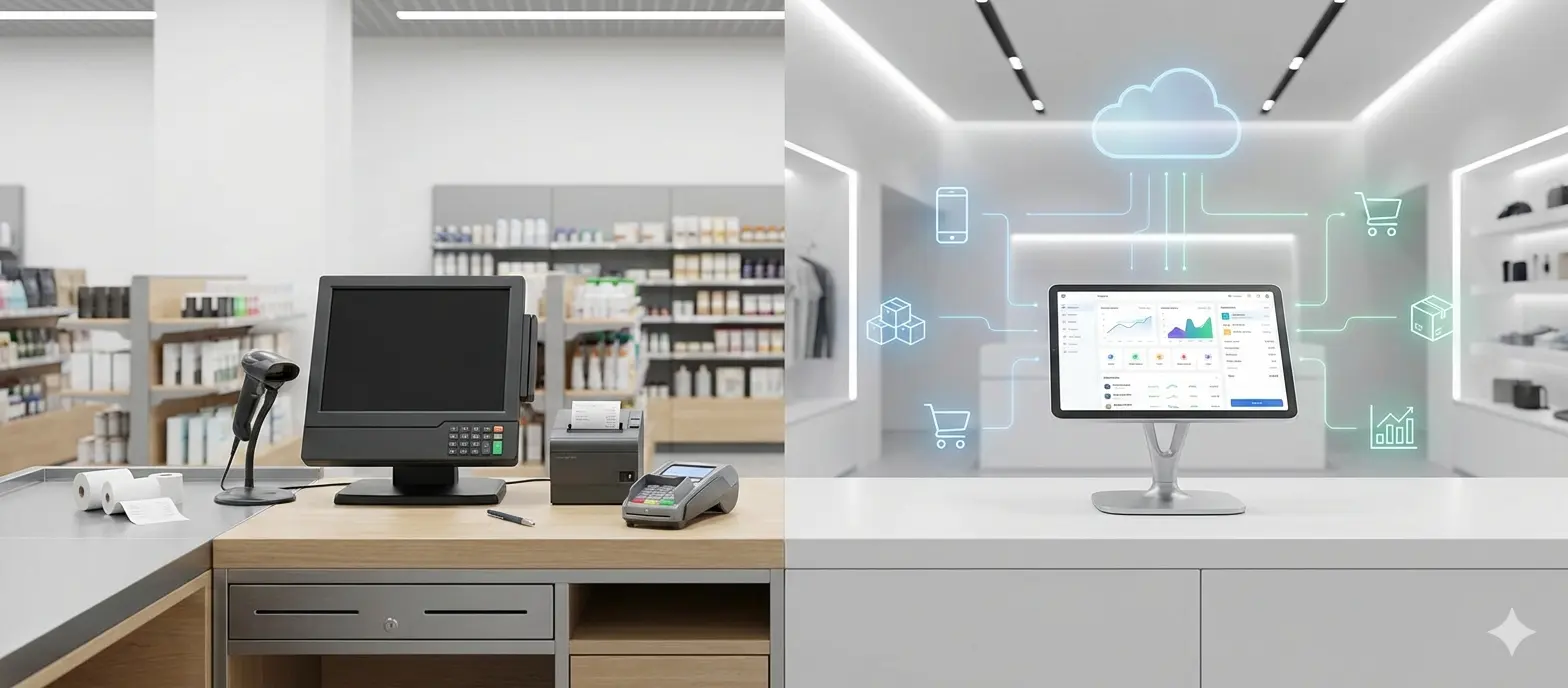
Legacy vs Modern POS: A Simple Comparison
The core differences between a register-based model and a platform-based architecture come down to how each system is deployed, built, connected, and used.
- Deployment
- Legacy POS: Local servers or individual terminals in each store, with manual updates and onsite maintenance.
- Modern POS: Cloud-hosted or hybrid cloud-edge, with software updates delivered over the internet and central data storage plus offline support.
- Architecture
- Legacy: Monolithic applications that bundle UI, logic, and data tightly together.
- Modern: Microservices-based and headless, with decoupled front ends that tap into shared services through APIs.
- Integración
- Legacy: Ad hoc or batch integrations that create silos and reconciliation work.
- Modern: Real-time APIs and webhooks that connect POS with ERP, CRM, OMS, and analytics so all systems share the same data.
- Data and experience
- Legacy: Basic, delayed reporting and checkout as a bottleneck.
- Modern: Real-time, granular data that powers forecasting, pricing, personalization, and fast, flexible checkout that meets sub-four-minute expectations.
In short, the register is static and single-purpose. The platform is dynamic and strategic, a software-driven ecosystem that can keep evolving.
Future-Proofing POS: From Register Mindset to Platform Mindset
The move from register to platform is more than a technology refresh. It is a mindset shift.
Instead of viewing POS as an isolated tool to record sales, leading retailers treat it as a strategic platform for unified commerce. Recent industry guidance highlights a major architectural change. POS is no longer a single central system. It is one of several modular, extensible nodes inside a composable ecosystem, connected by a cloud-native, API-driven design.
For retail IT leaders and enterprise architects, the mandate is clear: build POS for change.
- New payment methods, checkout devices, and AI-driven experiences will keep arriving.
- Customer expectations for seamless, personalized journeys will keep rising.
A platform-based POS is how you keep up. It gives you the ability to plug in new capabilities quickly, deliver frictionless omnichannel experiences, and continually refine operations based on real-time data.
If your current POS feels more like a register than a platform, that is the opportunity.


 omnicanal y tiendas
 Ingeniería
 Technology Consulting